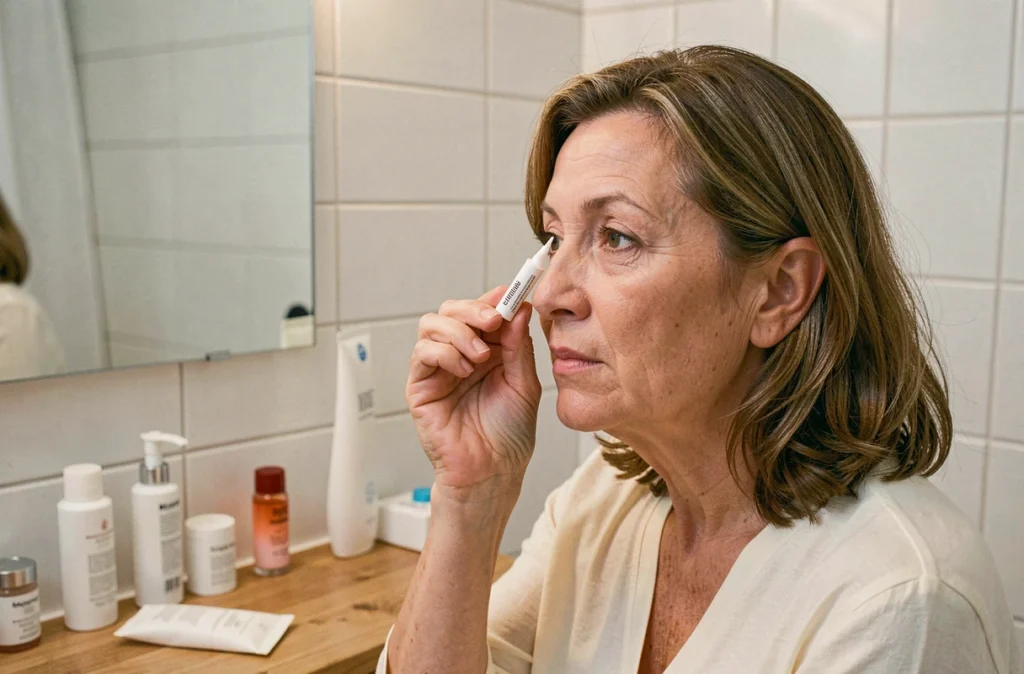
Sterdex is an ophthalmic ointment presented in the form of a single-dose soft capsule. Each capsule contains dexamethasone (a corticosteroid) and oxytetracycline (an antibiotic), two active ingredients intended to treat certain eye infections with an inflammatory component. Its direct application to the eye follows a specific protocol that conditions the effectiveness of the treatment and limits side effects.
Why Sterdex is not just a simple eye drop: pharmaceutical form and practical consequences
The most common confusion is treating the Sterdex capsule like a standard eye drop. An eye drop is liquid, dosed in drops, and spreads instantly over the ocular surface. Sterdex works differently.
The soft capsule contains a semi-solid ointment. Once punctured, it releases a greasy content that forms a film on the cornea. This film remains in contact with the tissues longer than an aqueous eye drop, prolonging the action of the active ingredients.
This greasy consistency leads to a temporary visual disturbance after application. Vision remains blurry for several minutes, sometimes longer. Applying Sterdex just before driving or operating machinery is a common mistake that is mentioned in the official notice from the ANSM.
Knowing how to apply Sterdex ophthalmic ointment first requires understanding this fundamental difference with an eye drop: the gesture, timing, and precautions are not the same.

Step-by-step application of Sterdex: the technical gesture
The application relies on a sequence to be followed in order. Any improvisation increases the risk of contaminating the container or under-dosing.
Preparation before application
- Wash hands with soap, then dry them with a clean cloth. Greasy or damp fingers complicate the handling of the capsule and can introduce germs
- Position yourself in front of a mirror or in a semi-reclined position, with your head slightly tilted back. This position facilitates access to the lower conjunctival sac
- Remove contact lenses if worn. The greasy ointment deteriorates soft lenses and prevents their proper adherence to the cornea
Opening the capsule and instillation
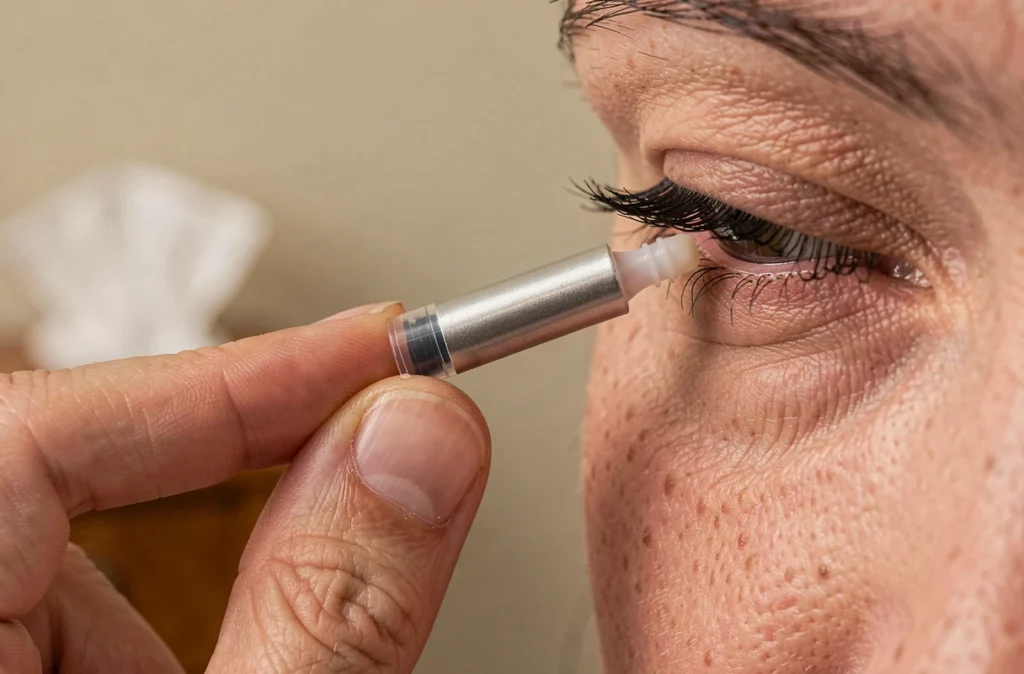
Twist the capsule between your thumb and index finger to locate the end to be punctured. The soft capsule is punctured by slightly twisting it, not by cutting it with scissors (which can uncontrollably project the contents).
With the index finger of the other hand, gently pull down the lower eyelid to expose the conjunctival sac. Squeeze the capsule to deposit all of the contents into this pocket, without touching the eye or eyelashes with the tip. Direct contact contaminates the container.
Release the eyelid, then close the eye for about thirty seconds. Some instructions recommend rolling the eyeball behind the closed eyelid to spread the ointment. Avoid blinking quickly: this expels some of the product out of the eye.
After application
Immediately dispose of the used capsule. The single-dose container cannot be stored after opening, even if there is remaining product. Reusing an opened capsule exposes you to a risk of infection, as sterility is no longer guaranteed.
Wipe away any excess ointment that overflows onto the eyelid with a sterile compress, without rubbing the eye.
Common mistakes with Sterdex ophthalmic ointment
Three mistakes frequently occur and compromise the treatment.
Extending treatment without medical advice is the most risky. The dexamethasone contained in Sterdex is a corticosteroid. Used beyond the prescribed duration, it can cause an increase in intraocular pressure and, ultimately, corticosteroid-induced glaucoma. The product characteristics summary published in the Public Database of Medicines explicitly mentions this risk with prolonged use.
The second mistake is using Sterdex for self-medication on a common conjunctivitis. Recommendations relayed by Health Insurance in 2025 specify that local ophthalmic antibiotics are no longer the first-line treatment for mild conjunctivitis. These benign infections are first managed with eye washes and antiseptic eye drops. Corticosteroid-antibiotic combinations like Sterdex are reserved for severe forms or post-operative care in ophthalmology.
The third mistake: applying the ointment in the wrong order when an eye drop is also prescribed. The eye drop should always be applied before the ointment, with an interval of at least fifteen minutes between the two. The greasy ointment, applied first, forms a film that prevents the aqueous eye drop from penetrating properly.
Sterdex and ocular contraindications: checks before treatment
Sterdex is contraindicated in cases of herpes keratitis, dendritic keratitis, or any pure viral infection of the cornea. Dexamethasone worsens these infections by suppressing the local immune response. The ANSM notice also mentions ocular fungal infections as a contraindication.
Patients with open-angle glaucoma must report their condition before any prescription. Even brief use of a local corticosteroid can destabilize an already fragile intraocular pressure. Tonometrical control may be necessary during treatment.
The High Authority of Health has issued an unfavorable opinion on the reimbursement of Sterdex for simple infectious conjunctivitis, while maintaining a favorable opinion for post-operative care in ophthalmology and certain documented inflammatory infections. This distinction reflects the desire to limit the misuse of a corticosteroid-antibiotic combination for conditions that do not warrant it.
The single-dose capsule, dosage, and duration of treatment are determined by the ophthalmologist. Any modification of dose or duration without medical advice exposes to disproportionate systemic or ocular side effects compared to the expected benefit. The ophthalmic ointment Sterdex remains a prescription medication, not a comfort product.