The leisure market in France no longer resembles what it was five years ago. Indoor complexes are upgrading, intergenerational formats are being structured, and families are managing their spending differently. Understanding these changes helps in selecting activities that truly meet the expectations of a family group.
Indoor Leisure in France: A Market Restructuring Deeply
Covered leisure spaces are no longer just simple air-conditioned play areas. We are witnessing a rapid professionalization of the sector, driven by significant growth figures. The market for escape games in France has around 900 brands with 2,400 to 2,600 rooms, generating revenue exceeding 200 million euros and an estimated annual growth of between 5% and 7%.
Indoor play parks are following the same trajectory: indoor leisure companies recorded a growth of 15% between 2019 and 2023. This dynamism attracts investors who structure multi-activity offerings under one roof (arcade rooms, karaoke, billiards, immersive experiences).
For families, the benefit is tangible: one location concentrates several activities without dependence on the weather. Parents choose these complexes for their practicality and predictability, according to several reports relayed by regional press. Exploring leisure activities on U Games also allows one to gauge the extent of this offering, from board games to more physical formats.

Intergenerational Activities: Overcoming the Divide Between Children and Adults
Segmentation by age (activities “for children,” activities “for adults”) hinders the quality of shared time. The most relevant formats today are those that mix generations around a common goal.
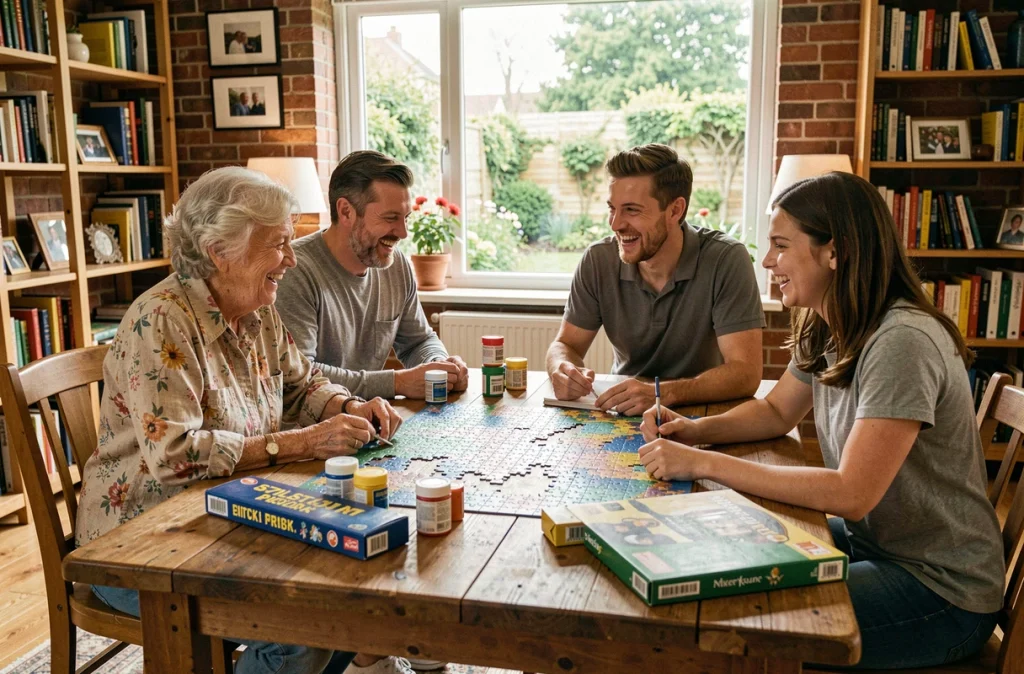
Intergenerational workshops in nursing homes illustrate this logic well. Structured programs involve children with elderly residents, with documented results on reducing isolation. This model is beginning to spread in the private leisure sector.
Multigenerational travel represents another rapidly growing segment. Grandparents, parents, and children share a stay designed so that each age group finds its place without constantly separating. We recommend prioritizing activities that create real interaction between generations rather than those that simply juxtapose them in the same space.
Criteria for Identifying a Truly Intergenerational Activity
- The activity requires cooperation between participants of different ages (not just co-presence in the same place)
- The level of difficulty adapts without excluding anyone: a six-year-old and a sixty-year-old can contribute significantly
- The format generates verbal or physical exchanges (collective cooking, cooperative board games, shared craft workshops) rather than passive consumption side by side
Family Leisure Budget: Where Does the Money Really Go?
The cost of a family outing to a theme park can exceed 140 euros according to Entrevue. This budget item is one of the first to be sacrificed when households have to make choices. A significant portion of French families has a limited vacation budget, which drives them to select activities with the best cost-duration ratio.
Leisure is the first expense category that families cut during budgetary constraints. This means that the value for money of an activity becomes as crucial a selection criterion as its attractiveness.
Three levers allow for maintaining regular leisure practices without blowing the budget:
- Structured at-home activities (modern board games, creative workshops with reusable materials) offer a very low cost per hour of entertainment compared to outdoor outings
- Multi-activity indoor complexes allow for shared travel and often entry costs, unlike scattered single activities
- Nature formats (hiking, park games, organized picnics) remain the most financially accessible, provided they are structured to avoid boredom for the youngest

Nature and Outdoor Activities: Structuring the Outing for Success
A free walk in the forest, without preparation, rarely lasts more than twenty minutes before children lose interest. A successful nature outing relies on a scenario prepared in advance.
The most effective approach is to attach a concrete goal to the outing: identifying species with a mobile app, collecting natural elements for a creative workshop upon return, or a navigation course marked by parents the day before. The playful framework transforms the walk into an engaging activity for all age groups.
Outdoor Sports Leisure: Adjusting Intensity to the Group
Walking and swimming remain among the most practiced sports activities in France. For a family group, we recommend calibrating the duration and intensity to the least enduring member. A two-hour bike ride is suitable for teenagers, but not for a five-year-old child or a grandparent with mobility limitations.
Short formats (one to one and a half hours) with integrated breaks and a point of interest midway work better than long linear outings. Shared enjoyment counts more than performance or distance covered.
Indoor complexes simplify organization and absorb weather uncertainties, while a well-planned nature outing retains the advantages of cost and direct contact between generations. In both cases, an activity that works for all ages relies on a cooperative format and a duration calibrated to the least enduring participants.