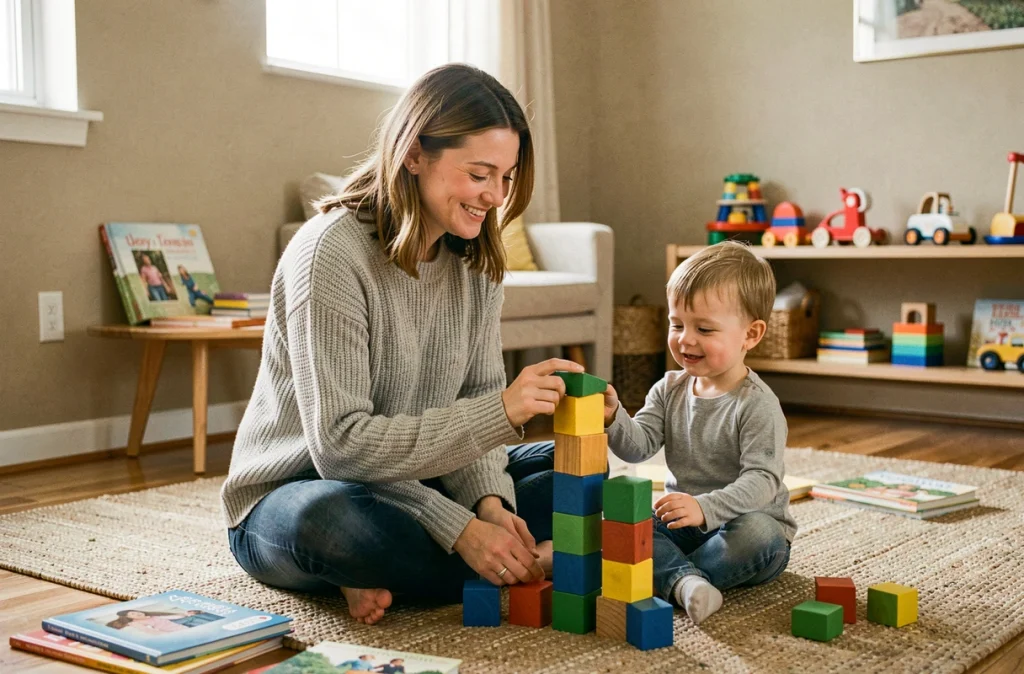
The evening meal turns into a tug-of-war, bedtime drags on, and patience melts away like snow in the sun. We all know those moments when the kindness we wish to show clashes with accumulated fatigue. Supporting our children daily without exhausting ourselves requires less theory and more concrete reflexes, adapted to the reality of an already busy parenting day.
De-escalating a crisis before it erupts: spotting the weak signals
A child starting to fidget in their chair, a voice tone rising, a toy gripped a bit too tightly in hand. These micro-signals almost always precede an emotional explosion. The classic reflex is to intervene once the crisis has set in, whereas spotting the weak signals allows us to act in advance.
In practical terms, we can place a hand on the child’s shoulder and name what we observe: “I see you’re gripping your fork, you seem upset.” This simple verbalization often suffices to reduce the tension a notch. The child feels acknowledged without the need to raise our voice.
When the crisis erupts nonetheless, staying at the child’s physical level (squatting or sitting) changes the dynamic. We move from a vertical authority posture to a face-to-face exchange. This is not laxity; it’s a choice of posture that facilitates a return to calm, including for us.
Many online resources support parents on Maman Zen in this approach of active listening and gentle parenting in daily life.

Evening parental rituals: three markers that change bedtime
The bedtime moment crystallizes a lot of family tension. The child is tired, the parent is too, and every passing minute feels like a diplomatic negotiation. Instead of multiplying the rules, we benefit from focusing on a few stable markers.
- A clear transition signal: turning off the main light in the living room or lowering the music volume physically marks the shift to quiet time, without needing to repeat it verbally every night.
- A short connection moment: two or three minutes of exclusive exchange (no screens, no parallel tasks) just before bed. We can ask, “What was your best moment today?” which directs the brain towards the positive before sleep.
- An identical ritual ending: the same phrase, the same gesture, the same sequence. Repetition reassures the child and reduces negotiations because the sequence becomes automatic.
Feedback varies on this point: some children need more flexibility in the ritual, while others cling to every detail. We adjust according to temperament, not according to a one-size-fits-all model.
Gentle parenting and clear limits: two compatible concepts
One of the most persistent misunderstandings about gentle parenting is the belief that it excludes limits. In practice, it’s the opposite: setting a clear framework is an act of kindness towards the child, who needs markers to feel secure.
The difference lies in how these limits are formulated. “You don’t hit” followed by “I understand you’re angry” acknowledges the emotion while maintaining the rule. We don’t need to justify the rule for ten minutes or negotiate it at every occurrence.
When the child tests the limit for the tenth time
That’s normal. Testing limits is part of development, especially between the ages of two and six. The parental role is to uphold the rule without emotional escalation. A short phrase, a neutral tone, and we move on.
If we feel anger rising within us, taking ten seconds before responding is not an admission of weakness. It’s a concrete tool. We breathe in, mentally rephrase what we were going to say, and intervene more accurately.

Parental mental load: lighten without fully delegating
The mental load is not just about the shopping list or medical follow-ups. It also includes the emotional management of the household: anticipating frustrations, planning for difficult transitions, keeping in mind the needs of each child. This invisible dimension weighs heavily on family daily life.
A concrete lever is to make visible what is invisible. We can display a simple chart in the kitchen with recurring tasks for the week, divided among the adults in the household. This is not a control tool; it’s a dialogue support that avoids “you could have thought of that.”
- Identify the three parental tasks that generate the most tension (often homework, bath time, and morning preparation) and alternate their distribution.
- Accept that the other parent’s way of doing things will not be identical to yours. Let go of control over how to do it to share how much.
- Plan a short weekly slot (even fifteen minutes) to check in with adults on what works and what doesn’t.
The trap of parental perfection
We won’t be the ideal parent at every moment of the day. Moments of fatigue, impatience, or clumsy responses are part of the journey. What matters in family support is the overall trend, not each isolated interaction.
When we have reacted too strongly, returning to the child afterward to say, “I lost my temper, that wasn’t fair” models exactly what we want to convey: acknowledging one’s mistakes is a relational skill, not a sign of weakness.
The National Conference on Parental Support, launched on February 19, 2026, by the Ministry of Solidarity, reflects a desire to structure parental support on a national scale. A decree from July 2026 also harmonizes the framework for parental leave in the public service, with an expected implementation date of January 1, 2027.
This text covers, among other things, permissions for prenatal appointments, caring for sick children, and parent-teacher meetings. These advances confirm that the parental role is gradually being recognized as a public policy issue, beyond the private sphere.
Daily life with children does not magically simplify. But every small adjustment, every listening reflex integrated into the routine, builds a stronger family bond over time.