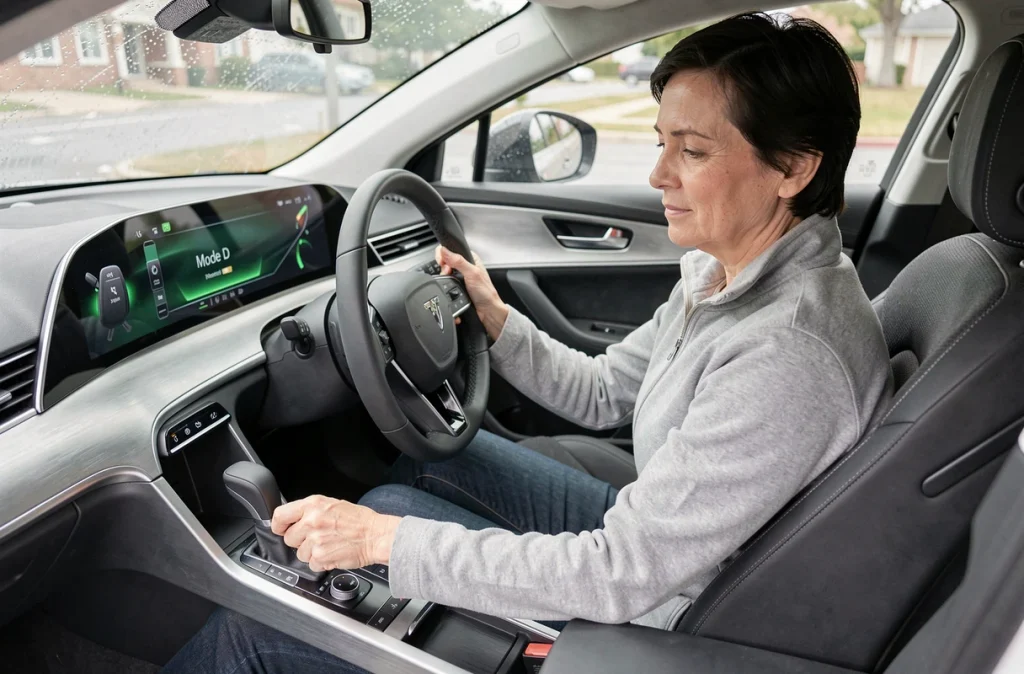
On an electric car, the gear selector generally offers two forward driving positions: D and B. The difference lies in the intensity of regenerative braking, that is, the amount of energy recovered when the driver releases the accelerator pedal. Comparing these two modes requires measuring their actual effect on range, energy consumption, and wear on mechanical components.
D Mode and B Mode on Electric Cars: Technical Comparison
| Criterion | D Mode (Drive) | B Mode (Brake) |
|---|---|---|
| Deceleration on lift-off | Low, partial coasting | Marked, pronounced engine braking |
| Energy recovery | Limited | Higher at each deceleration |
| Use of mechanical brakes | Frequent | Reduced |
| Driving comfort on the highway | Smooth, little unwanted slowing | Perceptible deceleration upon release |
| City driving or downhill | Regular use of the brake pedal | Almost “one-pedal” driving |
In D mode, the car behaves like a traditional automatic vehicle: releasing the accelerator results in a very gentle slowdown. In B mode, the electric motor reverses its role and acts as a generator, which slows the vehicle while sending energy back to the battery.
This table summarizes a simple principle. Understanding B mode in an electric car involves measuring the trade-off between energy recovery and driving comfort depending on the type of journey.
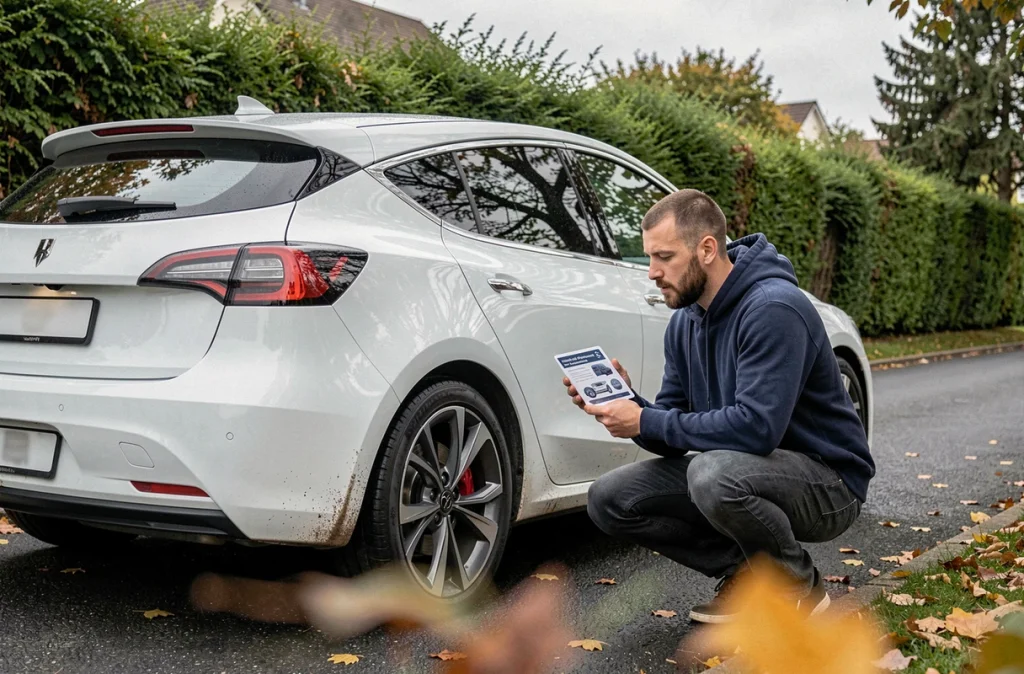
Regenerative Braking and Range: What Physics Imposes
B mode recovers more energy at each deceleration. This statement is true, but it does not mean that driving in B mode systematically increases overall range.
The energy gain from regenerative braking depends on the speed at the moment of release, the elevation change, and the available deceleration distance. On a highway journey at stabilized speed, deceleration phases are rare. B mode only recovers energy when decelerating, not when the car is cruising at a constant speed.
On the other hand, in urban driving with frequent stops, B mode multiplies micro-recoveries. Every red light, every slowdown in traffic feeds the battery instead of dissipating energy as heat in the brake discs.
The Trap of Compensatory Overconsumption
Several drivers on specialized forums report a counterintuitive effect. In B mode, the pronounced deceleration sometimes forces the driver to re-accelerate to maintain the desired speed. On open roads, this deceleration-reacceleration cycle consumes more energy than the coasting of D mode.
On the highway, D mode is generally more economical because it allows the car to glide without unnecessarily converting kinetic energy. B mode has the advantage on hilly routes, downhill, and in heavy traffic.
Brake Wear in B Mode: An Underestimated Mechanical Advantage
The impact of B mode on mechanical braking components is a rarely addressed angle in D/B comparisons, even though it has direct consequences on maintenance costs.
The less you use the pads and discs, the longer their lifespan. On an electric vehicle primarily used in B mode with anticipation, the brake pads can last much longer than on an equivalent combustion vehicle. The brake pedal only comes into play for final stops or emergency braking.
A technical paper published by SAE in 2026 links increased use of regenerative braking to a direct decrease in particulate emissions related to braking. Brake linings are a notable source of fine particles, and reducing their use provides a concrete environmental benefit beyond just the question of range.
Disc Corrosion: The Paradoxical Effect of B Mode
Driving almost exclusively in B mode creates an opposite problem. The brake discs, being less used, are exposed to moisture without the friction of the pads cleaning their surface. The result: superficial corrosion can appear on the discs, causing vibrations and reducing the effectiveness of mechanical braking when it is truly needed.
Several maintenance guides dedicated to electric vehicles, particularly for Renault models, recommend periodically performing strong braking to clean the friction surfaces. This precaution is simple but often forgotten by drivers who adopt “one-pedal” driving all the time.
- Perform a firm braking every few trips to keep the discs clean
- Monitor for vibrations or unusual noises when braking, signs of advanced corrosion
- Check the condition of the calipers during servicing, as their seizing is a documented risk on electric vehicles that are not mechanically braked much
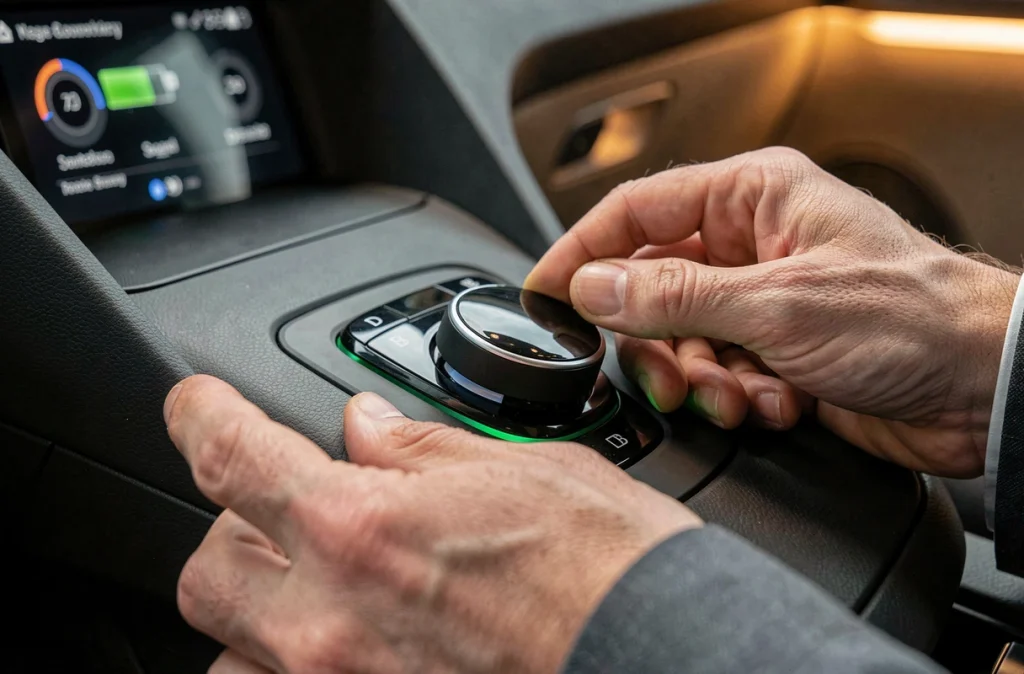
Which Mode to Choose Depending on the Type of Journey
The choice between D and B is not binary. Most experienced drivers alternate between the two modes depending on the context, just as one adapts their gear ratio in a manual transmission.
- City and traffic jams: B mode reduces right foot fatigue, recovers energy at each stop, and limits brake wear
- Constant speed on national roads: D mode allows the car to roll in inertia, avoiding unnecessary deceleration-reacceleration cycles
- Prolonged descents in the mountains: B mode maintains a controlled speed without overheating the brakes, while significantly recharging the battery
- Highway: D mode remains preferable, as deceleration phases are too spaced out for B mode to provide a measurable gain
B mode is not superior to D mode in all circumstances. Its advantage is concentrated in situations where decelerations are frequent and where the driver’s anticipation allows for almost total avoidance of mechanical braking. On smooth routes, D mode better preserves the vehicle’s kinetic energy.
The most determining factor remains the driving style. A gradual acceleration followed by anticipation of slowdowns yields better results than the choice of mode, whatever it may be. The D/B selector is a tool, not a substitute for eco-driving.