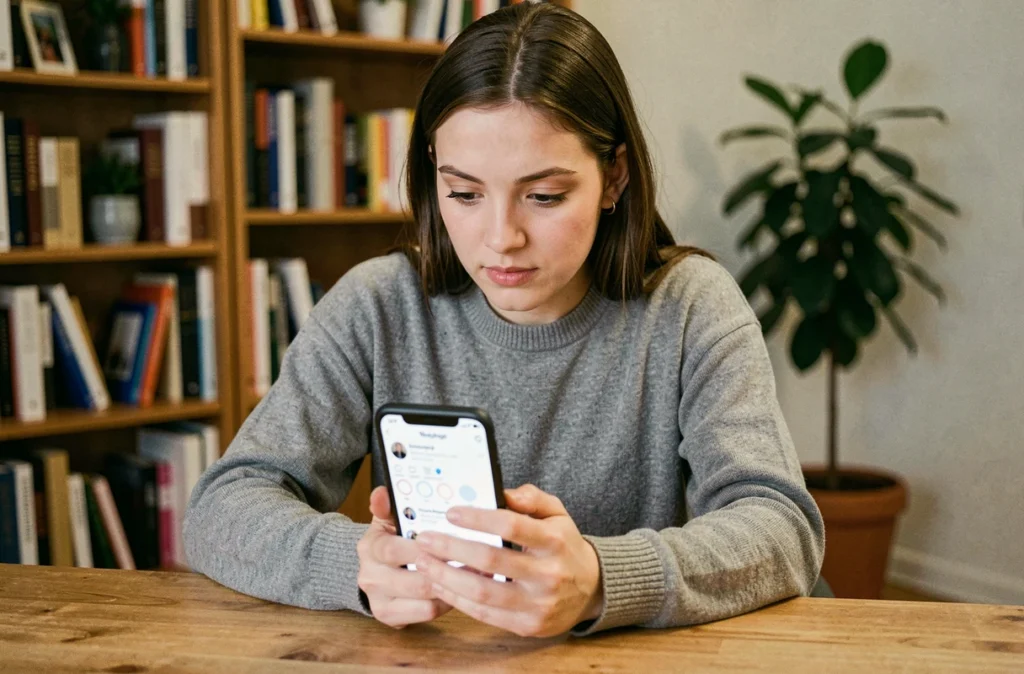
You find an Instagram account that’s a perfect match for your target audience. The profile is polished, the account is active, and the industry is relevant. You’re looking for a way to contact this person by email, but no address is listed. This is a common scenario, since most Instagram accounts don’t display a visible email address.
Instagram contact button: why it’s often missing
The most common instinct is to look for a “Contact” button below the profile name. This button is only available on accounts set up as professional accounts (creator or business).
The account owner chooses whether to display it and which contact details to include. The absence of a button doesn’t mean Instagram is hiding an email address: the account may be personal, or its owner may simply have decided not to publish their contact details.
When the button is available, it may offer an email address, phone number, or physical address. Tap it: if an email address appears, this is the only method that guarantees the person chose to make it public so they could be contacted. There are several ways to find the email address of an Instagram account when this button is missing, but they aren’t all equally reliable.

Guessed or published email address: an important distinction
Have you noticed that some tools claim to “find” an email address using just a name and domain? The result may look like a real address, but it’s often an algorithmic guess.
Here’s an example. You find a freelance graphic designer on Instagram. Her name is in her bio, and her website uses a custom domain. A search tool infers that her email address is [email protected]. This address may work, but it was never voluntarily published to receive inquiries.
Public contact details and reconstructed addresses
The difference is clear. An address displayed in an Instagram bio, on a contact button, or on the “contact us” page of a website linked to the profile is contact information that was voluntarily published. Its owner expects to receive messages.
An address guessed by cross-referencing data (name, company, common format such as [email protected]) is reconstructed data. In France, reconstructing a professional email address may constitute the processing of personal data, with the obligations that entails.
- First, check whether the address appears on the Instagram profile, in the bio, or via the dedicated contact button.
- Next, visit the website linked in the bio: the “contact” page or legal notices often include a mailing address.
- If you use a search tool, document where the address came from and make sure your message is relevant to the recipient’s professional activity.
Google searches and cross-referencing profiles: practical methods when no details are visible
When the Instagram profile doesn’t provide any information, take your search off the platform.
Google search operators
Enter the Instagram username in quotation marks in Google, followed by “email” or “contact.” For example: “@username” email. Google sometimes indexes portfolio pages, professional directories, or profiles on other platforms that use the same username and include an email address.
This method works particularly well for content creators and freelancers who use the same username across multiple sites.
LinkedIn profiles and other social networks
A professional Instagram account often belongs to someone who also has a LinkedIn profile. On LinkedIn, contact details (including email addresses) are sometimes visible to first-degree connections. Matching details across the two profiles (same name, same occupation, same photo) can help confirm you’ve found the right person.
Cross-referencing social profiles is the most reliable method after using the Instagram contact button. It gives you access to addresses the person has entered themselves on a professional platform.

Email outreach from Instagram: what you need to know
Finding an email address is one thing. Using it is another, and the rules vary depending on the context.
For B2B outreach, the message must be relevant to the recipient’s profession. The person must be informed about how their contact details will be used and be able to object easily. A clear unsubscribe link in every email is the bare minimum.
For individuals, prior consent is generally required before sending any commercial marketing message. Sending a promotional email to a personal address found on Instagram without explicit consent may lead to complaints.
Instagram direct messages and email: two different frameworks
Available legal sources point to some uncertainty over how messages sent through a social network’s messaging service are classified. To be safe, it’s best to apply safeguards similar to those used for email: clearly identify the sender and provide an easy way to opt out of future messages.
Why take this precaution? Because recipients don’t always distinguish between an Instagram DM and a marketing email. Their perception—and potentially their legal response—will be the same when faced with an unsolicited message.
Email search tools: what they do and what they don’t guarantee
Several online tools claim to find an email address from a social profile URL or a name associated with a domain. They generally rely on aggregated databases and deductions based on common email formats.
These tools don’t prove that an address is public or that it can be used without taking precautions. An address may come from a data breach, an outdated directory, or a simple algorithmic guess. Anyone responsible for outreach must be able to justify the source of every address they use.
- A tool that “verifies” an address only confirms that it technically exists (the server accepts messages), not that its owner consents to being contacted.
- SMTP verification doesn’t replace checking the source: where did the address come from, and does the person know it’s being used?
- Documenting the source of every contact is an obligation for the data controller, not an option.
The fact that data is accessible online does not, by itself, determine the conditions for reusing it. An email address found through a third-party tool deserves the same care as one collected through a form: provide information, allow people to object, and delete it on request.
The safest approach is to prioritize addresses voluntarily published on the profile, the linked website, or another official channel. When no contact details are visible, a polite direct message asking for the email address is the approach that best respects the contacted person’s choice.