
The Trottine 55 umbrella stroller impresses with its lightness and compact size, but its folding mechanism can confuse many parents on a daily basis. Online content often limits itself to general presentations, without detailing the precise gestures or the common causes of blockage. This article outlines the technical gestures, points of verification, and mistakes to avoid in order to fold and unfold this model without forcing it.
Diagnosing a blockage before forcing the chassis
When the folding mechanism resists, the first instinct is to push harder. This is exactly what you should not do. A mechanism that gets stuck on the Trottine 55 almost always indicates an identifiable obstacle within seconds.
Three common causes arise regularly. An overloaded lower basket prevents the chassis tubes from coming together. A removable accessory (safety bar, tray) left in place blocks the folding motion. Misaligned front wheels, remaining in a pivoting position when they should be straight, create a hard point at the hinges.
The most reliable test is to operate the folding mechanism empty, without a bag in the basket, without accessories, and without a child. If the movement becomes smooth, the problem lies with the load or a part that hasn’t been removed properly. If the hard point persists when empty, the cause is likely within the mechanism itself, often a latch that is not engaged properly or a hinge that needs lubrication.
Several recent guides on umbrella strollers confirm that a persistent squeak when empty distinguishes a hinge issue from a simple obstruction problem. Identifying the source of the blockage before insisting helps avoid twisting a part and turning a minor adjustment into an expensive repair. To find all the tips for handling the Trottine 55 stroller step by step, a detailed operating procedure complements this diagnosis usefully.

Folding the Trottine 55 stroller: the sequence to follow
The folding of an umbrella stroller relies on a specific order. Reversing two steps is enough to block the mechanism, and the Trottine 55 is no exception.
Preparing the stroller before folding
Start by removing anything that protrudes from the chassis: diaper bag in the basket, toys hanging from the bar, canopy raised to the maximum. Every accessory left in place is a potential obstacle. Bring the front wheels to a fixed position (not pivoting) so that both wheels are parallel to the rear wheels. This detail stabilizes the structure during the descent of the chassis.
Engaging the folding mechanism
Locate the handle or the release latch on the handlebar. On umbrella models like the Trottine 55, this unlocking requires a simultaneous action: pull the handle while pushing the handlebar forward and down. The movement should be continuous, without jolts. A jerky motion re-engages the safety latch halfway through.
When the chassis reaches the low position, an audible click confirms the locking in the folded position. If this click does not occur, the stroller is not secured and may unfold during transport.
Points to check after folding
- Check that the locking latch is properly engaged by gently pulling on the handlebar: the stroller should not reopen.
- Secure the moving parts (front wheels, canopy) to prevent them from getting caught in a staircase or car trunk.
- If you plan to transport it by plane, measure the folded stroller including the wheels to ensure it complies with the dimensions allowed in the cabin or cargo.
Unfolding the Trottine 55: mistakes that jam the mechanism
Unfolding seems simpler, but it generates just as many blockages as folding, often because the parent pulls in the wrong direction.
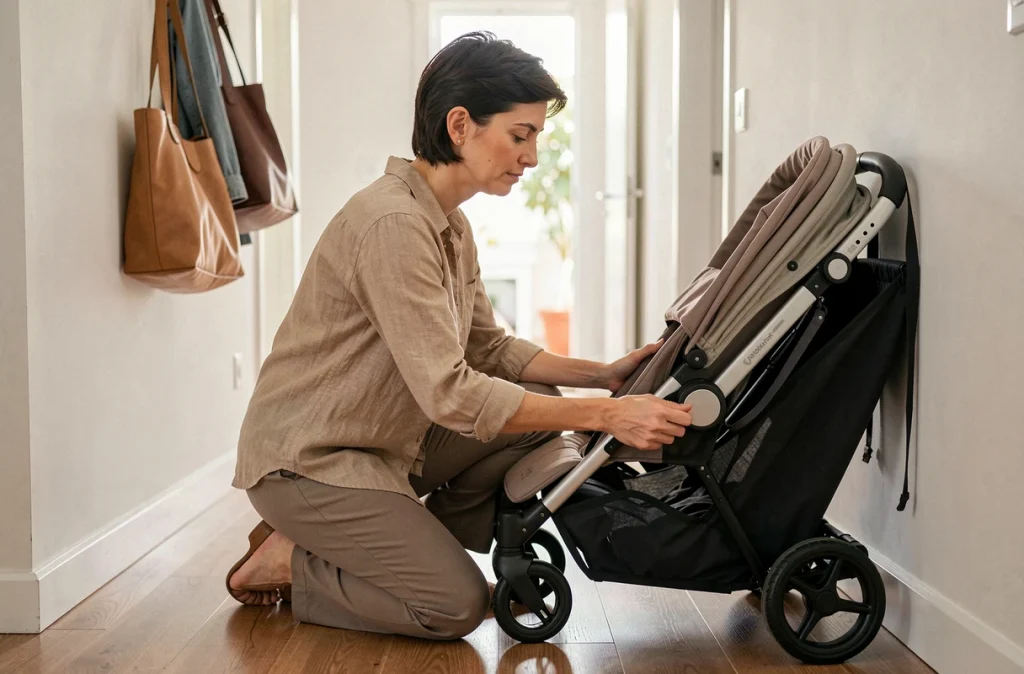
The folded position latch must be released before any upward pull. Look for the button or tab that keeps the chassis folded, press it, and only then pull the handlebar upward and backward. Pulling without unlocking puts strain on the central hinge and can damage the safety clip.
Once the chassis is deployed, push the handlebar until you hear the click of locking in the open position. Check the rigidity by pressing on the seat: the chassis should show no lateral play. If you feel any looseness, the locking is not complete. Fold it slightly and redeploy, ensuring that the main tube is properly inserted into the hinge housing.
Maintaining the folding mechanism to avoid premature wear
A mechanism that worked perfectly at first can become stubborn after a few months of use. The most common cause is the accumulation of dirt in the hinges. Sand, crumbs, sidewalk dust accumulate in the joints and create friction points.
Cleaning the hinges with a damp cloth every two to three weeks is sufficient in most cases. For persistent squeaking, a drop of silicone lubricant (not cooking oil, which attracts dust) on each pivot restores the smoothness of movement.
Avoid storing the folded stroller in a damp place for long periods. Humidity promotes the oxidation of metal axles, making folding progressively harder. Vertical storage, in a dry closet, better preserves the mechanism than horizontal storage in a garage.
- Check the condition of the locking clips once a month: a cracked clip no longer holds the chassis in the folded or unfolded position.
- Check the alignment of the front wheels by rotating them by hand: abnormal friction indicates a slightly bent axle that may hinder folding.
- If the mechanism remains stiff after cleaning and lubrication, a trip to customer service is necessary, as the central hinge may have developed play.
A well-maintained folding mechanism remains smooth throughout the stroller’s usage. Recurring blockages are almost never related to a design flaw: they indicate maintenance needed or a gesture to correct. Taking thirty seconds to empty the basket and align the front wheels before each folding saves many frustrations on the sidewalk.