
After a hip prosthesis placement, the resumption of walking relies on a technical aid prescribed as soon as the patient leaves the hospital. The walker provides stable support that limits mechanical stress on the operated joint during bone and tissue healing. Not all models are suitable for this rehabilitation phase: the type of frame, its height, and its mode of movement must correspond to the patient’s functional status, week after week.
Partial support and hip biomechanics: what the walker must compensate for
The surgeon generally prescribes a progressive partial weight-bearing during the first weeks. The body weight is then partially transmitted through the upper limbs, via the walker handles, to relieve the operated hip.
This distribution of forces protects the prosthesis while the bone consolidates around the implant. A walker that is too low forces the patient to lean forward, altering the load axis and increasing pressure on the joint. A walker that is too high requires the shoulders to be raised, causing neck pain and rapid fatigue in the arms.
The correct height is adjusted simply: standing with arms at the sides, the top of the handles should reach the level of the wrist crease. This adjustment ensures almost complete elbow extension during support, which transfers the load effectively without compensating with the back. Therefore, before validating a model, it is essential to ensure that the adjustment range covers the patient’s height, within a few centimeters.
To choose a suitable walker for this biomechanical constraint, consulting a physiotherapist remains the most reliable starting point, as they assess the patient’s actual weight-bearing capacity and not just their morphology.

Fixed, articulated, or wheeled frame: which type after hip prosthesis
The confusion between different categories of walkers sometimes delays the return home. Three main families cover almost all postoperative prescriptions.
- The fixed frame walker (four feet, no wheels) offers maximum stability. The patient lifts it with each step and places it in front of them. This operation is suitable for the first few days when balance is still precarious and pain limits movement speed. Its limitation: it imposes a discontinuous walking pattern that slows progress towards fluid ambulation.
- The articulated frame operates on the same principle, but each side moves independently. The movement more closely mimics natural walking, with a left-right alternation. This model is suitable as soon as the patient sufficiently controls their balance to coordinate their supports.
- The walker with two front wheels (the rear feet remain fixed) combines gliding and passive braking. It allows for a more continuous walk without the patient needing to lift the frame. This compromise is often favored by physiotherapists after the first week of rehabilitation, as it promotes a regular step while maintaining a good level of safety.
Four-wheeled rollators with a seat and hand brakes serve a different need. They are more suited for outdoor movement and for patients whose rehabilitation is already well advanced. In the early phase after a hip prosthesis, their maneuverability can become a trap: the ease of rolling gives a false impression of stability, and late braking on wet or uneven ground can cause exactly the type of fall that rehabilitation aims to avoid.
Weight of the frame and patient size: two criteria often overlooked at the time of purchase
Buying guides often detail the number of wheels and the type of handles but quickly overlook the weight of the walker itself. After a hip intervention, muscle fatigue appears quickly. A frame that is too heavy exhausts the arms and discourages daily walking exercises, which slows rehabilitation.
Fixed aluminum frames remain the lightest. Wheeled models weigh more due to the wheel mechanism and, sometimes, an integrated seat. For exclusive indoor use (hallway, living room, bathroom), a light and narrow model facilitates maneuvers in the limited spaces of the home.
The patient’s size also influences the choice. A standard frame generally supports a weight up to a certain limit indicated by the manufacturer. Heavier individuals should check this maximum capacity before purchasing, as an undersized frame will bend under the load and lose its stable support function.
Frame width and door passage
A rarely anticipated point: the overall width of the walker must fit through the narrowest door frame in the home. Measuring this passage before leaving the hospital avoids the need for equipment exchange in the days following the return home, a period when mobility is most limited.
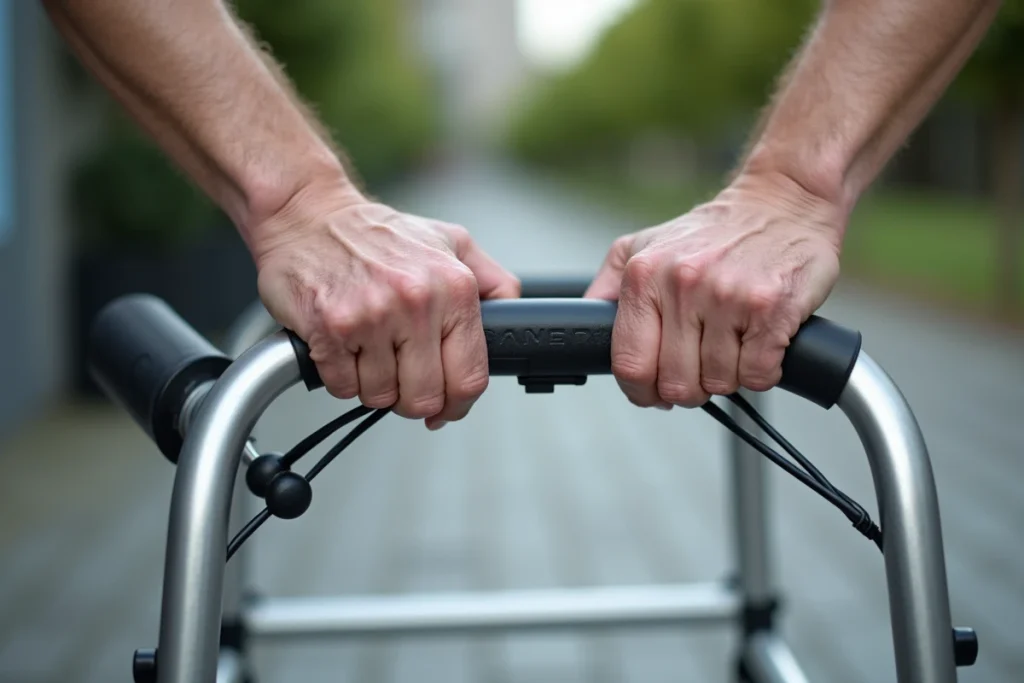
Connected walkers: a tracking option for post-operative rehabilitation
Recently, rollators incorporating motion sensors and fall alert systems have appeared on the market for technical aids. These devices record the distance traveled, the regularity of the step, and any imbalances.
For a patient in rehabilitation after a hip prosthesis, this data allows the physiotherapist to adjust exercises between sessions, without relying solely on the patient’s feelings. Detecting a recurring imbalance on the operated side, for example, can signal a postural compensation that needs to be corrected before it becomes established.
However, these models remain relatively rare. Their cost, the need to recharge a battery, and the learning curve of the interface limit their adoption, particularly among older patients. Technology is advancing, but the mechanical walker remains the standard upon hospital discharge.
Choosing a walker after a hip prosthesis is not just a matter of catalog selection. The rehabilitation phase evolves quickly: a fixed frame useful in the first week can become a hindrance by the third week. Planning from the start the possibility of transitioning to a wheeled model, in agreement with the physiotherapist, avoids a double purchase and supports the patient’s real progress towards autonomy.