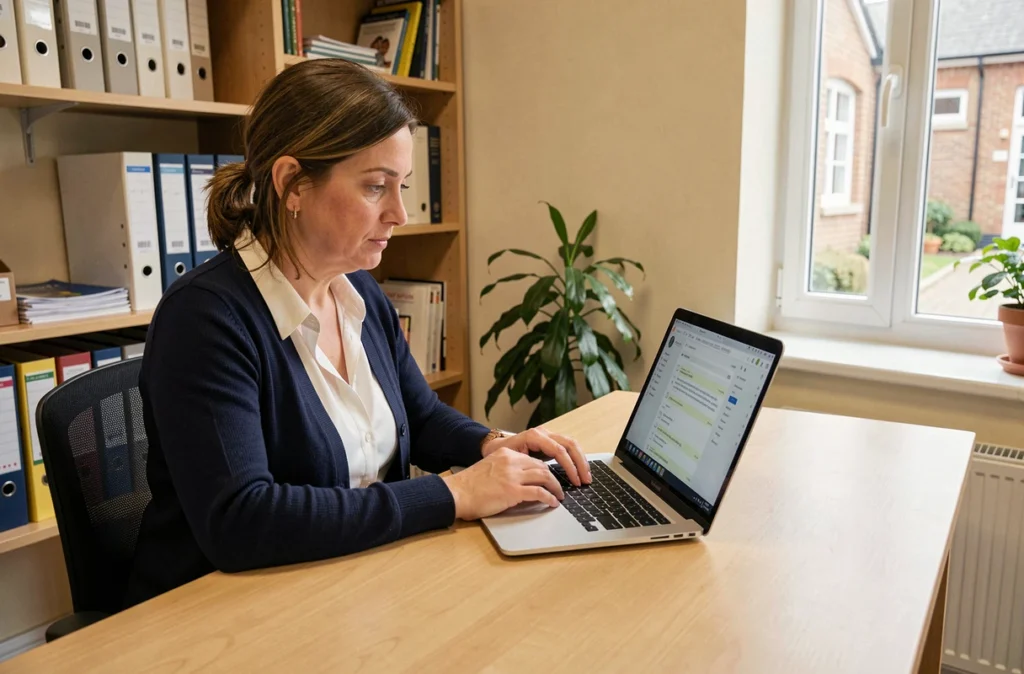
The webmail of the Dijon academy is based on an address in the format [email protected], accessible from the academic intranet portal (PIA) or directly via the URL webmail.ac-dijon.fr. This professional messaging service is the official channel for all exchanges related to public educational services: communications between teachers, correspondence with administrative services, career notifications.
Multifactor Authentication: What Changes for Logging into Dijon Webmail
Several French academies are now deploying multifactor authentication (MFA) to secure remote access to academic applications, including messaging. This system adds a layer of verification beyond the simple username/password pair.
The principle is simple: after entering your username and password, a second verification factor is required. This can be a temporary code (OTP) sent via SMS, generated by an authentication app on your phone, or provided by a dedicated academic token.
For the Dijon academy, the DSI strongly recommends this system when you connect from a network outside the institution. If you attempt to access the Dijon academy webmail from your home or a public Wi-Fi network, MFA significantly reduces the risk of identity theft. Even if your password is compromised, the temporary code blocks access to unauthorized third parties.

Academic Identifier and NUMEN: Building Your Login Access
The email identifier follows a specific construction rule: the first letter of the first name followed by the last name, all in lowercase, without spaces or periods. For Anne-Marie Durand, the identifier would be adurand. For a hyphenated name like Le Pont, the hyphen is retained: ale-pont.
Case of Homonyms in the Academic Directory
When two agents share the same identifier, the academy adds a number as a suffix (adurand1, adurand2). This assignment is managed by the DSI at the time of account creation. If your identifier does not work on the first attempt, it is often because a homonym exists in the directory.
Initial Password and NUMEN
The default password upon first login is your NUMEN, an official identifier of the National Education composed of thirteen characters (numbers and uppercase letters). This NUMEN appears in your career file on the digital workspace, or can be requested from your institution’s personnel service.
After the first login, the system prompts you to change this password. Choose a combination of at least twelve characters mixing uppercase, lowercase, numbers, and special characters. Never reuse your NUMEN as a permanent password, as it is known to several administrative services.
IMAP Configuration on Smartphone: Academic Server Settings
Accessing your academic email from a mobile phone requires configuring a mail client (Mail on iOS, Gmail or others on Android) with the IMAP protocol. This protocol synchronizes messages between the server and your device: an email read on your phone appears as read on the webmail, and vice versa.
Here are the settings to enter in your mail client:
- IMAP incoming server: imaps.ac-dijon.fr, port 993, SSL/TLS encryption enabled
- SMTP outgoing server: smtps.ac-dijon.fr, port 465, SSL/TLS encryption enabled, authentication required
- Username: your full academic identifier ([email protected])
- Password: the one you use for webmail (not the initial NUMEN if you have changed it)
On iOS, the configuration goes through Settings, then Mail, then Accounts, then Add Account, then Other. On Android, the procedure varies by manufacturer, but the general path remains Settings, then Accounts, then Add mail account.

Why Avoid Automatic Forwarding to Personal Email
Some agents configure a redirection of their academic emails to Gmail, Orange, or Hotmail. This practice poses two concrete problems. The first is technical: several consumer providers block emails redirected from academic servers, treating them as spam. The second is regulatory: professional exchanges sometimes contain student data or HR information subject to GDPR, and their transit through a non-contracted third-party server creates a compliance breach.
GDPR and Academic Messaging: Obligations Regarding Sensitive Data
Professional messaging regularly carries personal data: student names, academic results, reports, career documents. GDPR requires that this data circulates within a secure technical framework and that its processing is documented at the institution level.
Each institution must maintain a record of data processing, including those that pass through messaging. Sending an unencrypted attachment of a student list to a personal address constitutes a potential breach.
For academic messaging, best practices include encrypting sensitive attachments, using the ac-dijon.fr address exclusively for exchanges containing student data, and regularly deleting obsolete messages containing personal information.
National Convergence of Academic Messaging: What Lies Ahead
Several French academies are already merging their messaging portals. In Normandy, the former webmail.ac-caen.fr and webmail.ac-rouen.fr have been replaced by a single portal webmail.ac-normandie.fr, with a transition to enhanced authentication via EduConnect. Other academies are gradually transitioning to messagerie.education.gouv.fr for daily access.
This trend towards centralization could eventually change the URL and the login procedure for Dijon webmail. The academic identifiers would remain the same, but the access portal and the authentication mechanism would evolve towards a unified national system.
For now, webmail.ac-dijon.fr and the PIA remain the two operational entry points. Keeping your password up to date and activating MFA as soon as the option is offered remains the best preparation for these changes.