
The term “ricil” refers to a lash treatment formulated with castor oil, applied without colored pigment, whose primary function is to nourish the lash fiber. Mascara, on the other hand, is a pigmented makeup product that alters the appearance of lashes immediately upon application. Both act on the same ground, but their mechanisms and results only overlap superficially.
Mascara and ricil: two formulas with distinct objectives
A mascara contains waxes, pigments, and film-forming polymers. Its role is to coat each lash to give it volume, length, or curl instantly. The result is visible within seconds and disappears upon makeup removal.
A ricil is based on castor oil, sometimes enriched with peptides or biotin. Its action aims to nourish and protect the keratin of the lash over time. It does not color or volumize: it conditions. The effect is measured in weeks, not minutes.
Understanding the choice between mascara or ricil involves identifying what one truly expects from their daily beauty routine: an immediate aesthetic result or foundational care.

Castor oil in lash care: what cosmetics promise and what they prove
Castor oil is the cornerstone of most ricils and many so-called “care” mascaras. It is commonly presented as a lash growth accelerator. The reality deserves a more careful reading.
Evidence on lash growth remains limited. Castor oil nourishes the hair fiber, enhances its flexibility, and reduces breakage. However, no solid data demonstrates that it accelerates the growth cycle of the lash itself. This distinction matters because it shapes expectations.
Protecting a fragile lash from dehydration and breakage is already a tangible benefit. Less brittle lashes appear longer over time, not because they grow faster, but because they fall out less. It is this mechanical effect that maintains the confusion between strengthening care and growth serum.
Hybrid care mascaras: an expanding category
The market now offers hybrid care mascaras that combine pigments and nourishing actives (castor oil, peptides, biotin). These formulas seek to combine makeup and care in a single step.
Their appeal is real for those who wear mascara every day and wish to limit mechanical aggression on their lashes. Their limitation: the concentration of actives is generally lower than that of a pure ricil, as the formula must also hold, pigment, and not run.
Formula and makeup removal: the true criterion for sensitive eyes
The choice between mascara and ricil is not just about appearance. For sensitive eyes or contact lens wearers, the composition and ease of product removal weigh as much as the result.
- A waterproof mascara offers long-lasting hold but requires a bi-phase or oily makeup remover and repeated rubbing. These rubs weaken the lashes over time and irritate the periocular area.
- A classic formula mascara (non-waterproof) is easier to remove, reducing mechanical stress on the lashes. In return, its hold is less resistant to humidity or heat.
- A pure ricil requires no makeup removal since it is transparent and absorbed by the fiber. It is the least aggressive option for the eye area.
- Hypoallergenic formulas, whether mascaras or ricils, limit preservatives and fragrances that may trigger reactions. Checking the INCI list remains the most reliable reflex.
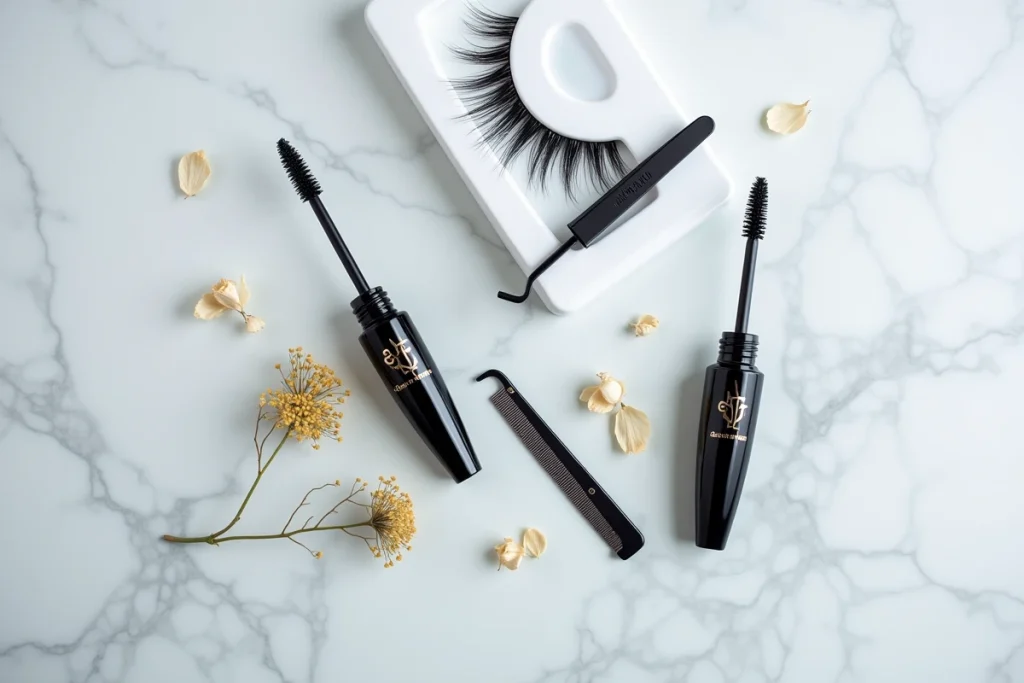
Mascaras brush and ricil texture: adapting the product to the morphology of your lashes
The brush of a mascara influences the result as much as its formula. A thick brush with tightly packed bristles deposits more product and is suitable for fine lashes that lack density. A fine, curved brush targets curl and separation, ideal for straight or overlapping lashes.
The choice of brush depends on the morphology of the lashes, not on current trends. Short and sparse lashes will benefit more from a volumizing mascara than a lengthening one, regardless of fashion.
Ricil texture: fluid or balm
A fluid ricil penetrates quickly and is suitable for application in the evening before bed. A balm ricil, thicker, stays on the surface longer and leaves a noticeable protective film. The choice between the two depends on the time of application and tolerance for a greasy feel on the eyelids.
Daily mascara or ricil: building a coherent routine
Opposing mascara and ricil does not always make sense. Both products can coexist in the same routine, provided they are used at the right time.
- The ricil is applied in the evening on clean, makeup-free lashes, allowing the castor oil to work overnight.
- The mascara is applied in the morning, on dry, non-greasy lashes, for an immediate eye effect.
- Alternating classic mascara during the week and ricil alone on weekends helps reduce the exposure of lashes to film-forming agents while maintaining regular care.
A ricil does not replace a mascara for a visible made-up effect, and a mascara, even enriched with castor oil, does not replace dedicated care applied to bare lashes. Treating the two as complementary rather than competitive yields better long-term results.
The most reliable selection criterion remains reading the formula: a short INCI list, absence of fragrance for reactive skin, and a brush format suited to the shape of one’s own lashes. Everything else is marketing.