The Greek open-air markets are not just simple places of sale. In Greece, the term laïki agora refers to a periodic open-air market where agricultural producers and professional sellers offer their products according to a specific regulatory framework. In Corinth, a city in the Peloponnese situated between the eponymous canal and ancient ruins, these markets remain the most direct point of contact between visitors and local know-how.
Mandatory signage at Greek markets: what travelers can read on the stalls
Since the reform of open-air trade resulting from law 4849/2021 and its recent revisions, each market stall in Greece must display visible signage. Producers are required to present a sign stating “ΠΑΡΑΓΩΓΟΣ” (producer), their name, their license number, and their reference to the agricultural registry.
Professional sellers, on the other hand, display a distinct sign with the mention “ΕΠΑΓΓΕΛΜΑΤΙΑΣ ΠΩΛΗΤΗΣ”. This system allows anyone, even without speaking Greek, to immediately identify whether the stall offers products grown or made by the seller themselves, or if it is a reseller.
This detail changes the visit. During a getaway among the markets of Corinth, spotting the sign “ΠΑΡΑΓΩΓΟΣ” means identifying the stalls where olives, honey, or herbs come directly from local farms in the Corinthian region.
Agricultural products from the Corinth region: what the stalls reveal about the terroir
The plain of Corinth and the surrounding hills, particularly the Nemea area, produce an agricultural range that local markets faithfully reflect. Corinthian raisins are among the most emblematic products: small, dark, concentrated in natural sugar, they are dried using methods passed down through generations.
Olive oil occupies a central place at the producers’ stalls. The Koroneiki variety, dominant in the Peloponnese, yields a fruity oil often cold-pressed in small family units. Thyme and oregano honey, harvested from the limestone slopes, is another recurring product.
On the Nemea side, the agiorgitiko grape variety fuels a recognized wine production. Markets in the area sometimes offer bulk wine or bottles from local cooperative wineries. For a visitor coming from Athens, this concentrated agricultural diversity on a few stalls provides a quick insight into the Peloponnesian terroir.
Guidelines to distinguish local products from imported ones
- Check the regulatory sign “ΠΑΡΑΓΩΓΟΣ” that certifies the producer’s status and mentions their farm
- Observe the packaging: local producers often use simple containers (paper bags, jars without industrial labels), unlike factory-packaged products
- Ask about the origin: Corinthian producers can easily identify the village or plot of origin, while a reseller remains vague
Traditional crafts in Corinth: ceramics and know-how from the Peloponnese
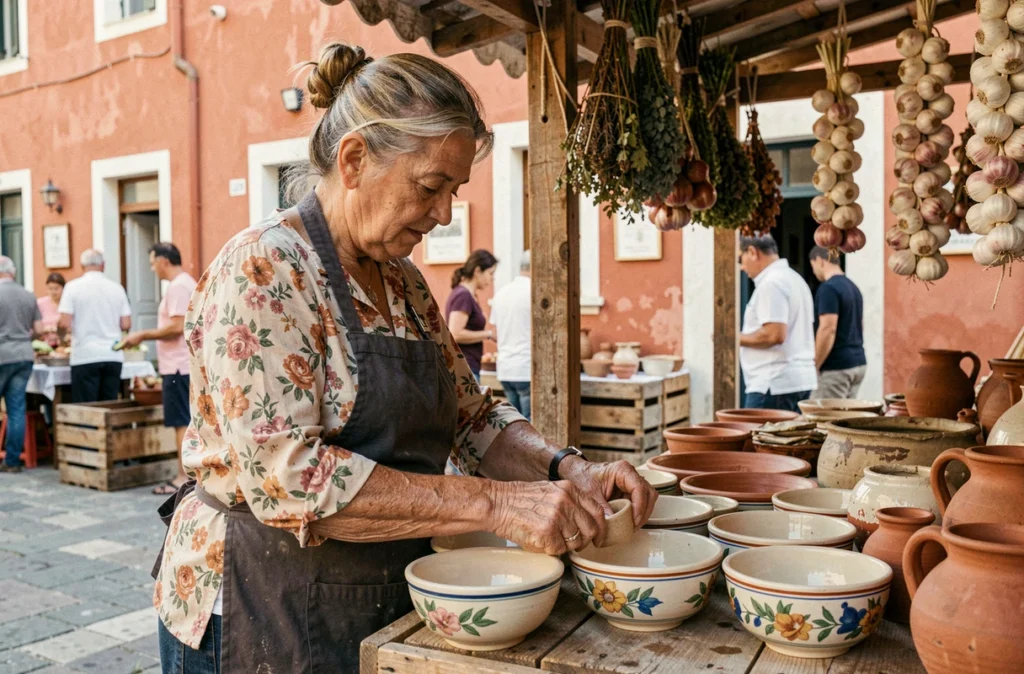
Corinthian craftsmanship is rooted in an ancient ceramic tradition. Ancient Corinth was a major center for the production of painted pottery, and this technical memory persists in contemporary forms. The Kilix Ceramic Crafts workshop, noted by visitors to the region, illustrates this continuity: clay is worked using techniques inspired by ancient Corinthian ceramics.
Handcrafted ceramics from Corinth are distinguished by their geometric patterns and earthy colors, inherited from the stylistic conventions of antiquity. The locally produced pieces, such as bowls, miniature amphorae, and reproductions of protocorinthian vases, are not mass-produced decorations. They involve manual shaping and controlled firing in small kilns.
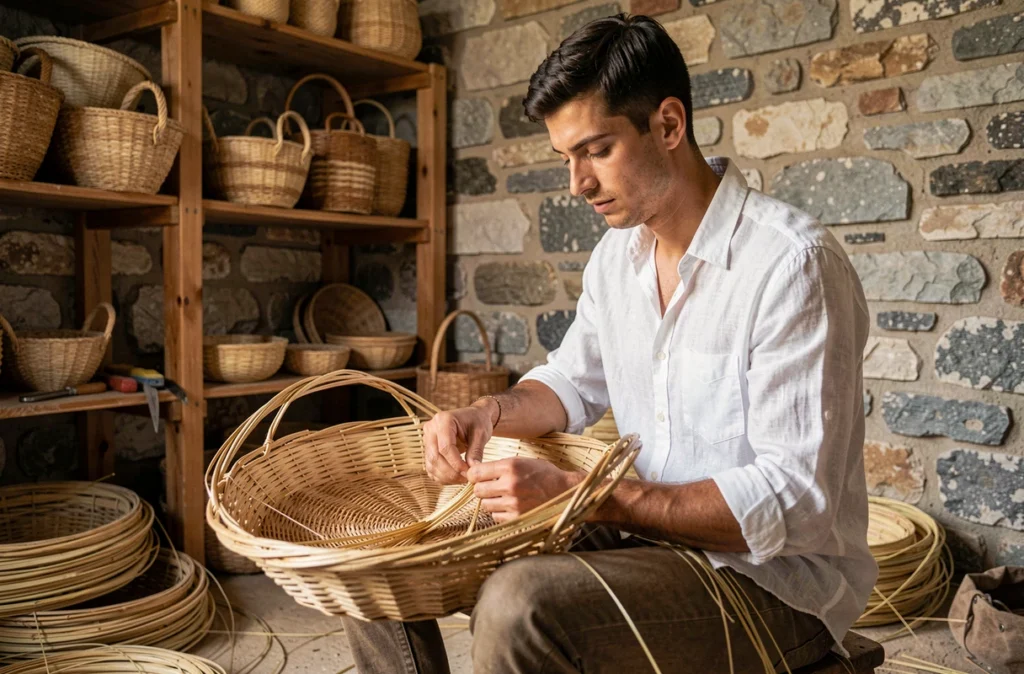
Beyond ceramics, other forms of craftsmanship persist in the region. Leatherwork, embroidery, and the production of olive oil soaps occasionally fill the stalls of artisan markets, especially those organized near the Corinth canal.
Seasonal artisan markets near the canal
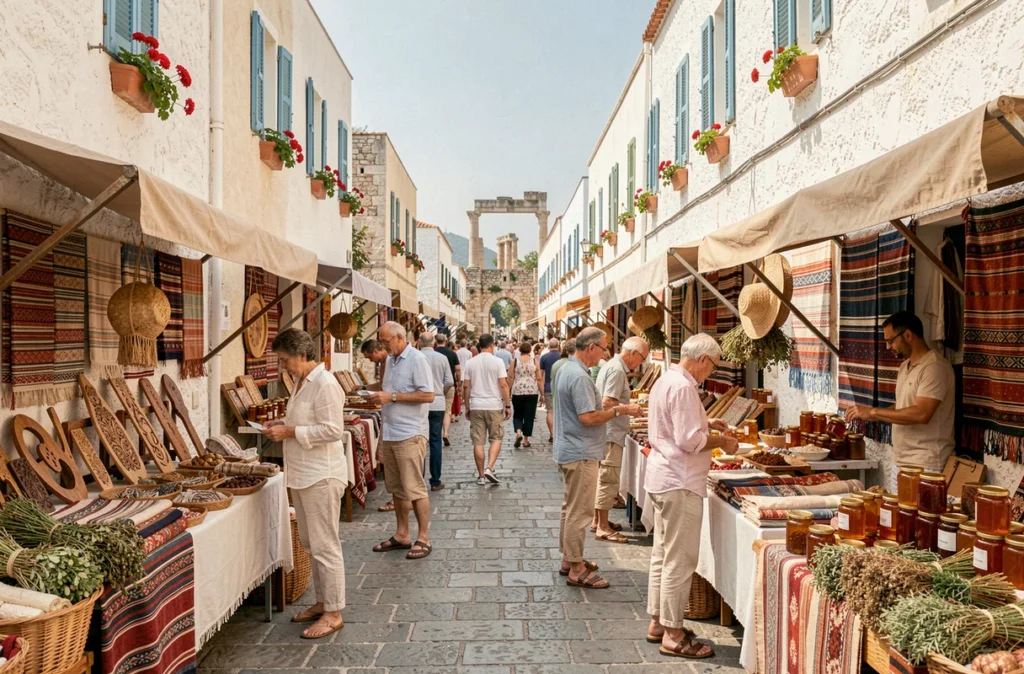
The Corinth canal attracts a steady flow of visitors, and seasonal artisan markets are held there. These events bring together artisans from the Peloponnese who showcase handmade jewelry, woven textiles, and olive wood objects. These seasonal markets concentrate in one place the craftsmanship scattered throughout the villages of the Corinthian region.
The frequency and dates vary from year to year. The Corinth Green Market, for example, organizes regular editions where food producers and creators of artisanal objects come together.
Atmosphere and rhythm of a Corinthian market: what changes compared to Athens
Markets in Athens, like Varvakios in the center of the capital, operate at a dense pace, with a constant influx and narrow aisles. In Corinth, the market life follows a different tempo. The stalls are fewer, exchanges with sellers are longer, and the overall atmosphere is less touristy.
A Corinthian market remains primarily a place of local life, not an attraction. Locals do their weekly shopping, chat with neighbors, negotiate prices. For a visitor used to Athenian neighborhoods, the contrast is stark: less noise, less commercial pressure, more direct contact with producers.
- Arriving early in the morning ensures the best selection, especially for fresh fruits and cheeses
- Saturday is often the main market day in medium-sized towns in the Peloponnese like Corinth
- Nearby taverns frequently serve dishes prepared with products bought that very morning
Discovering the markets of Corinth and its craftsmanship is not planned like a visit to an archaeological site. It relies on a slow pace, attention to the regulatory details of the stalls, and a curiosity for products whose quality stems from the proximity between the place of production and the place of sale. It is this short chain, from field to stall, that gives Corinthian markets their distinct character.